Speed-to-Lead, Explained: The Most-Studied Number in Sales That Almost Nobody Acts On
Two decades of research say the same thing: the business that answers first usually wins the job. Here's what the term actually means, what the data shows, and how to measure your own.
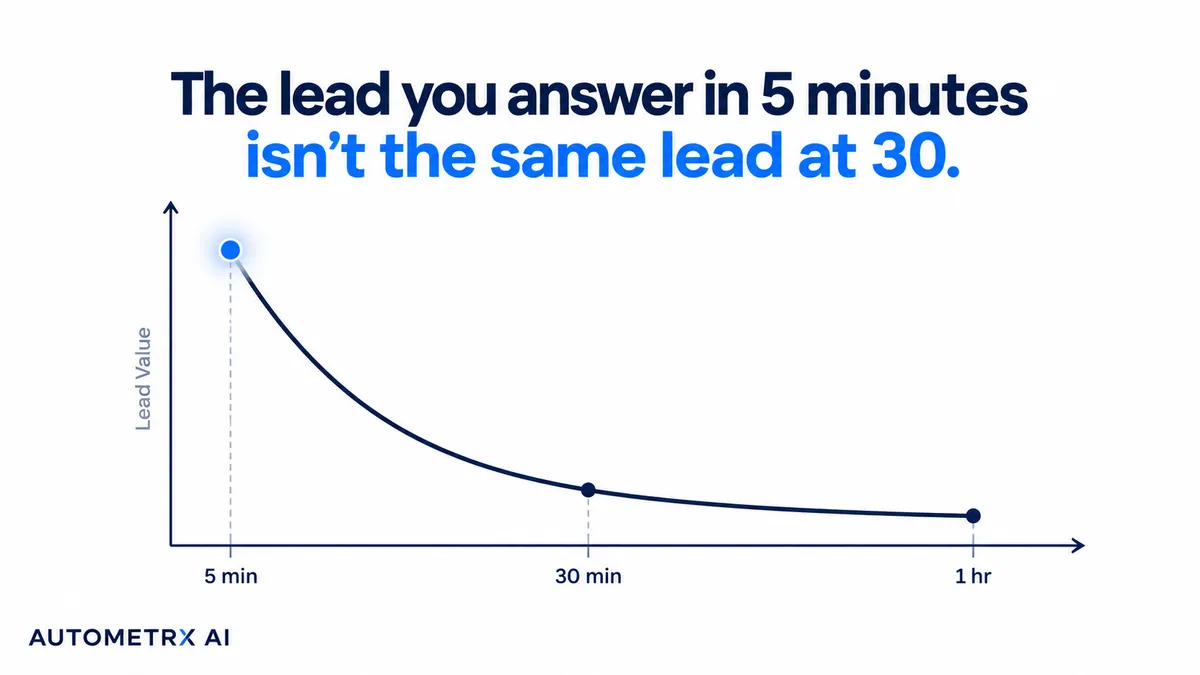
If you run a business that generates leads, you have probably heard the phrase "speed-to-lead" thrown around. It sounds like consultant jargon. It isn't. It's one of the most consistently researched relationships in all of sales, and the finding is blunt: the faster you respond to a new lead, the more likely you are to win it, and the drop-off when you're slow is not gentle. It's a cliff.
Here's the plain-English version, the data behind it, and how to check where your own business stands.
What speed-to-lead actually means
Speed-to-lead is simply the time between a prospect reaching out, a call, a form fill, a text, and your business making real contact back. Not an auto-reply. Not "we got your message." Actual contact, a person or an agent engaging with that specific lead.
That's the whole definition. The reason it matters so much is what happens to a lead's value as that clock runs.
What the research says, and where it comes from
The number everyone quotes traces back to a single well-known study, the Lead Response Management research led by Dr. James Oldroyd, conducted with InsideSales around 2007, which tracked more than 15,000 leads across a hundred-plus companies over three years. It remains the canonical citation for the whole field. Two of its findings have held up as the anchors of every discussion since:
Responding within 5 minutes instead of 30 makes you roughly 21 times more likely to qualify the lead. And responding fast makes you dramatically more likely just to reach the person at all, by some measures around 100 times more likely to make contact at 5 minutes versus 30.
Later work pointed the same direction. A widely cited Harvard Business Review analysis found that responding within an hour made firms far more likely to qualify a lead than waiting a day. And across studies, a striking share of buyers, often cited around three-quarters, end up going with the company that responds first.
One honest caveat, because it matters: the original 21x figure comes from vendor-platform data, not a laboratory experiment, and it's nearly two decades old. Treat the exact multiple as directional, not gospel. But the direction has been confirmed so many times, by so many independent sources, that the underlying rule is about as settled as anything in sales gets: faster is better, and the penalty for slow is severe.
The part that should bother every owner
Here's the gap that makes speed-to-lead worth an entire article. The rule is settled, and almost nobody follows it.
Study after study finds the average business takes not minutes but many hours, often more than a day, to respond to a new lead, and that a large share of web leads never get a response at all. Only a small minority of companies respond within five minutes. Read that alongside the research and the opportunity is obvious: in a race where most competitors don't leave the starting line for hours, you don't have to be the best business in your market to win the lead. You have to be the one that responds in minutes, because hardly anyone else does.
How to measure your own speed-to-lead
You can't improve what you don't measure, and most owners have never actually measured this. It takes ten minutes:
Grab your last ten leads, calls, form fills, and texts, from your phone log and inbox.
For each, find two timestamps: when the lead came in, and when someone at your business made real contact back (not an auto-reply, actual engagement).
Write down the gap for each. Then look at two things: your average, and your worst cases. The worst cases usually cluster after hours, on weekends, and during your busiest daytime rushes, exactly when you're least able to respond and, often, when your highest-value leads arrive.
Most owners guess their speed-to-lead is around ten minutes and discover, on measuring, that it's over an hour, with a long tail of leads that were never contacted at all.
Why this is so hard to fix with people alone
Once you've measured it, the problem becomes obvious and so does why it's stubborn. A five-minute response, every time, has to survive nights, weekends, lunch rushes, and moments when every line is already busy, across every channel a lead might use. No human team can staff that reliably. It isn't a discipline failure. It's arithmetic. This is precisely the gap an AI voice and chat agent is built to close: it responds to every lead in seconds, on every channel, at any hour, with a real qualifying conversation rather than an empty auto-text. You can hear what an instant response sounds like at autometrx.aidemo.app.
The bottom line
Speed-to-lead is the rare business metric where the research is overwhelming, the rule is simple, and the field is wide open because so few act on it. Measure yours this week. If the number surprises you, and it usually does, the free ROI calculator will translate that gap into what it's costing you.
The business that answers first usually wins. The only question is whether that business is yours.
Autometrx AI builds done-for-you AI voice and chat agents that respond to every lead in seconds, across phone, web chat, SMS, and Messenger, 24/7, for home service businesses and any business that runs on leads. Live in 5 days, done for you. Talk to the live demo or run the ROI calculator at autometrx.ai.